
AI Video Dubbing in Google Ads: Ultimate Guide

Ultimate guide on how AI video dubbing in Google Ads helps brands localize video ads, reach multilingual audiences, reduce production time, and scale campaigns.
Ultimate guide on how AI video dubbing in Google Ads helps brands localize video ads, reach multilingual audiences, reduce production time, and scale campaigns.

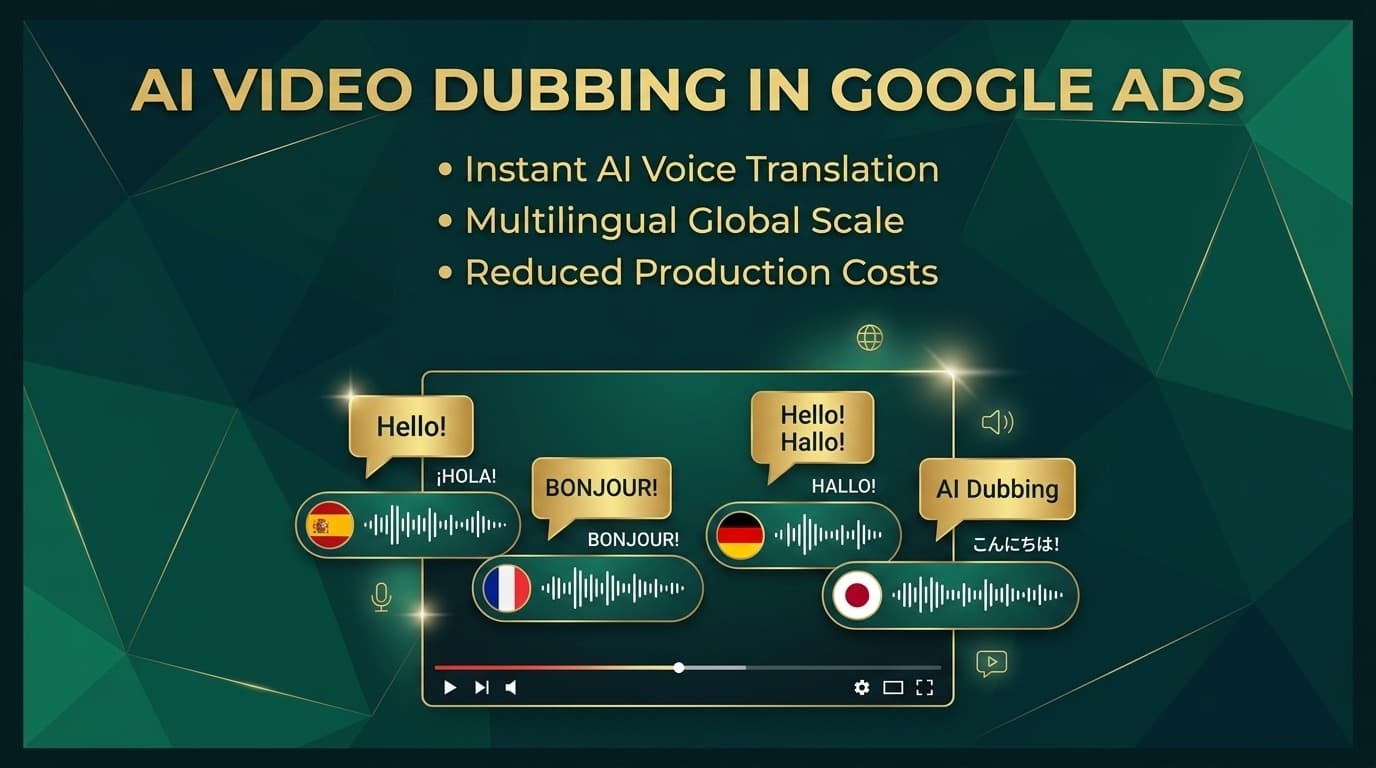
Ultimate guide on how AI video dubbing in Google Ads helps brands localize video ads, reach multilingual audiences, reduce production time, and scale campaigns.
AI video dubbing in Google Ads allows advertisers to adapt video campaigns for different languages without producing an entirely new recording for every market. By combining AI-generated voiceovers, translation, and video localization, businesses can create more accessible advertising experiences for multilingual audiences while reducing the production work involved in traditional localization.
For brands targeting international or multicultural audiences, AI dubbing can make video advertising easier to scale while giving marketers more opportunities to test localized campaigns.
AI video dubbing is the process of replacing or adapting spoken audio in a video into another language using artificial intelligence. Instead of recording a separate voice actor for every market, advertisers can use AI-powered voice technology to create localized versions of existing video content.
Within the Google advertising ecosystem, video campaigns can run across YouTube and Google video partners, while Google's advertising tools also provide AI-assisted options for creating video assets and voiceovers.
This makes AI dubbing useful for businesses that already have successful English-language video advertisements but want to reach customers who speak other languages.
Businesses can also combine video advertising with a broader digital marketing strategy that includes SEO, content marketing, web development, and conversion optimization.
Traditional video localization can require new scripts, voice actors, studio recording, editing, and multiple approval stages. For companies advertising across several markets, these requirements can increase both production costs and timelines.
AI dubbing can simplify the process, but it should be treated as a localization tool rather than a complete replacement for human review. Pronunciation, cultural references, humor, terminology, and brand messaging should be checked before publishing.
A typical AI dubbing workflow involves several stages.
These approaches solve different localization problems. For example, an English product advertisement targeting Urdu-speaking customers could retain its visual creative while using an Urdu voiceover. Another version could use English audio with Urdu subtitles. The right approach depends on the audience, campaign objective, creative format, and available production resources.
| Approach | What it does |
|---|---|
| AI dubbing | Replaces or recreates spoken dialogue in another language. |
| Subtitles | Preserves the original audio while displaying translated text on screen. |
| AI voiceover | Adds generated narration, which is useful when the original video does not contain extensive dialogue. |
AI video dubbing can support several advertising scenarios. Online retailers can localize product demonstrations, promotional videos, and explainer content. Software companies can use multilingual video ads to explain products and demonstrate features. Hotels, tourism companies, and travel brands can adapt destination-focused advertisements. Online courses can localize promotional videos for learners in different regions. Businesses serving multilingual communities can create localized advertisements without producing completely separate campaigns from scratch.
For companies developing a broader acquisition strategy, video advertising can also work alongside organic search. Marketing Eden's guide on SEO vs. paid ads explains how SEO and paid advertising address different growth objectives and can be used together.
A successful campaign should begin with audience research rather than translation. First, identify which languages your customers actually use. Then determine whether the audience responds better to translated audio, subtitles, or completely localized creative.
Next, adapt the message to the market. A literal translation may technically be correct but still sound unnatural to native speakers.
Your landing page should also match the localized advertisement. If the advertisement is in another language but the landing page remains entirely in English, the customer experience can become inconsistent.
This is where SEO and content strategy can support the wider campaign by aligning localized landing pages, keyword targeting, page structure, and content with audience search behavior. Marketing Eden's SEO service includes keyword research, content strategy, on-page optimization, internal linking, and content SEO.
AI dubbing should be evaluated based on business outcomes rather than simply the number of localized videos produced. Comparing localized versions against the original creative can reveal whether language adaptation is improving campaign performance.
If a localized video receives similar impressions but generates a higher conversion rate, that may indicate stronger audience-message alignment.
AI dubbing is not perfect. Common challenges include incorrect pronunciation, unnatural translations, timing problems, inaccurate terminology, and cultural differences.
Brand-sensitive industries should be especially careful. Legal, financial, healthcare, and technical advertising may require additional human review because small translation errors can change the meaning of important information.
Voice quality also matters. If the generated voice sounds unnatural or emotionally disconnected from the advertisement, localization may reduce rather than improve audience engagement. Human quality control therefore remains an important part of the workflow.
Video localization works best when it is connected to the rest of the marketing funnel. A multilingual advertisement may attract attention, but the customer still needs a relevant landing page, clear value proposition, persuasive content, and a simple conversion process.
Businesses can explore Marketing Eden's sustainable digital marketing funnel guide for a broader framework covering awareness, consideration, conversion, and retention.
The same principle applies to localized campaigns: every stage of the customer journey should provide a consistent experience.
The landing page is particularly important because a strong advertisement cannot compensate for a poor post-click experience. Businesses that need conversion-focused websites can use Marketing Eden's web development service.
The cost depends on the number of languages, videos, editing requirements, voice technology, and review process. The main potential advantage is scalability. Once a business has produced a strong master video, creating additional localized versions can require less production work than recording every version traditionally.
Google Ads' video creation tools have included AI-assisted voiceover functionality. Current Google Ads voiceover tools have supported up to 5 voice-over messages per video, with each message limited to 150 characters, illustrating how AI-assisted audio is becoming part of mainstream advertising workflows.
Advertisers should still compare production costs against actual campaign results rather than assuming that AI automatically makes localization profitable.
AI video dubbing is making multilingual video advertising more scalable by allowing businesses to adapt existing creative into additional languages without rebuilding every campaign from the ground up.
The strongest approach is not simply to translate a video. Advertisers should localize the message, review the generated voice, match the landing-page experience, and measure business results.
When combined with paid advertising, SEO services, conversion-focused web experiences, and a sustainable digital marketing funnel, multilingual video can become part of a broader digital growth strategy.
If your business is exploring multilingual advertising, contact Marketing Eden to discuss how video advertising, SEO, content, web development, and digital strategy can work together.
Google's advertising ecosystem includes AI-assisted video creation and voiceover capabilities. Specific availability and features can vary by product, account, market, and campaign setup.
Neither approach is universally better. Dubbing creates a localized spoken experience, while subtitles allow viewers to hear the original audio while reading translated text. The best option depends on the audience and campaign.
For some advertising applications, AI-generated voices can reduce production requirements. However, professional voice talent may still be preferable when emotional performance, highly specific pronunciation, or premium brand presentation is important.
Yes. If an advertisement targets a specific language audience, a matching landing-page experience can create a more consistent customer journey and reduce friction after the click.