SEO vs. Paid Ads Which Growth Strategy Is Right for Your Startup?

Compare SEO vs paid advertising to find the best growth strategy for your startup. Learn the pros, costs, ROI, and when to invest in SEO, PPC, or both.
Compare SEO vs paid advertising to find the best growth strategy for your startup. Learn the pros, costs, ROI, and when to invest in SEO, PPC, or both.

Compare SEO vs paid advertising to find the best growth strategy for your startup. Learn the pros, costs, ROI, and when to invest in SEO, PPC, or both.
You have a product. You have a little bit of a budget. And you have a board (or a spouse, or a savings account) asking when customers are going to show up.
So you start Googling. And within ten minutes, you've read three articles that all say the same thing: "It depends." Helpful, right?
Here's the honest answer. SEO and paid ads solve different problems. One builds a customer engine that runs for years. The other gets you customers by Friday. Most startups need pieces of both, just not at the same time, and not in the same amounts.
Let's break down how to actually decide.
Quick definitions, no jargon.
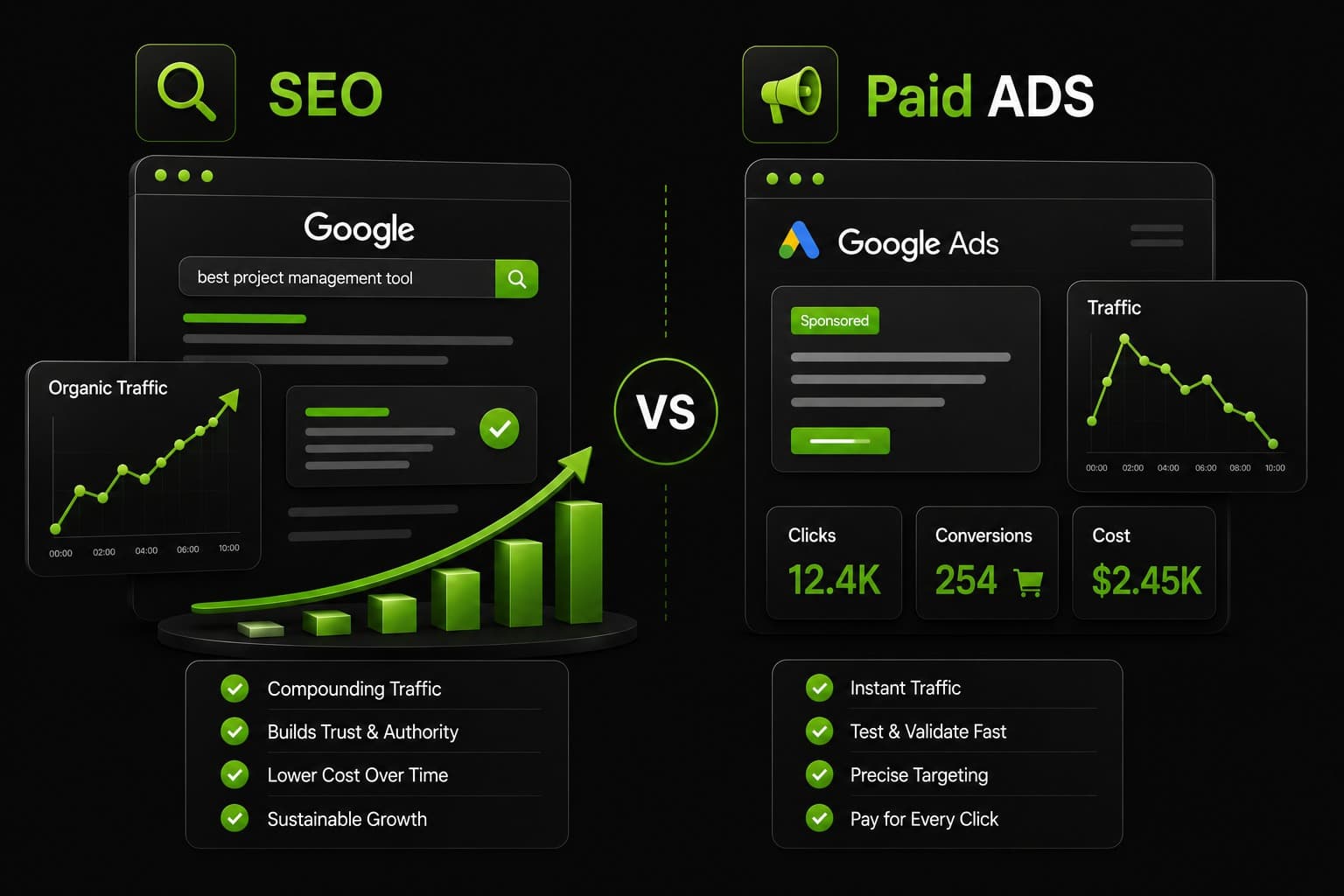
SEO (search engine optimisation) means writing content and structuring your website so Google shows you when people search for things related to your product. You don't pay per click. You pay with time, usually months of it, before it works.
Paid ads (Google Ads, Meta Ads, LinkedIn Ads) mean you pay for visibility right now. You bid on keywords or audiences, and your ad shows up immediately. Turn the budget off, and the traffic stops the same day.
That's the core trade-off in one sentence. SEO compounds slowly. Ads perform instantly, then disappear.
Imagine two ways to fill a bathtub.
Paid ads are like turning on the faucet full blast. Water fills fast. But the second you turn the tap off, the tub starts to drain.
SEO is like a slow drip that never stops, even while you sleep, even on weekends, even months after you wrote the article. It takes longer to notice. But it never turns off on its own.
Most founders want the faucet because they need water today. That's a completely reasonable instinct. But if you never build the drip, you'll be paying for every single drop of water, forever.
You have a runway of 12 months or more. SEO rarely pays off in month one. Often not in month three. If your cash situation demands results in six weeks, SEO can't promise that, and forcing it will just burn your patience along with your budget.
Your product solves a problem people actively search for. If your customers Google phrases like "best invoicing software for freelancers" or "how to file an LLC in Texas", there's real search demand to capture. If your product creates a brand-new category nobody's searching for yet, SEO has much less to grab onto early on.
You're building toward a long-term, defensible growth channel. Paid ads get more expensive as competitors bid against you. SEO, done well, tends to get cheaper over time relative to the traffic it brings in. If you're playing a multi-year game, that math matters.
You need revenue this quarter. Investors don't care that your blog will rank in eight months. If you need paying customers now to hit a milestone or simply to keep the lights on, ads are the tool built for that.
You're still testing product-market fit. Ads let you test messaging, pricing, and audience segments in days instead of months. You can run five different headlines and know by Thursday which one converts. SEO can't give you that kind of fast feedback loop.
You have a short sales cycle and clear unit economics. If you already know your customer acquisition cost and your customer's lifetime value, ads become a predictable math problem. Spend $50, get a $200 customer. That's a formula you can scale, as long as the numbers hold.
Real numbers, not vague ranges.
Paid ads: Most early-stage startups spend somewhere between $1,000 and $5,000 a month to get meaningful data. Below that, you often don't get enough clicks to learn anything useful. And that number is ongoing. It doesn't shrink once you find something that works. It usually grows.
SEO: Expect to invest $1,500 to $3,000 a month if you're paying for content and technical work or a serious chunk of founder time if you're doing it yourself. The catch is that this cost front-loads. An article you publish today can still bring in customers two years from now, without you spending another dollar on it.
Ask yourself three questions.
Yes, and honestly, this is what most successful startups end up doing. Just not evenly, and not on day one.
A common pattern looks like this: run paid ads first to get customers in the door and learn what messaging actually converts. Feed those insights, the exact words customers use, the objections that come up, and the pain points that land, into your SEO content. Your blog posts and landing pages become sharper because you're not guessing at what to say. You already tested it.
Over time, shift budget away from ads and let SEO take more of the weight. Ads become the tool you turn back on for launches, promotions, or slow months, not your only source of customers.
Think of it less as "SEO vs. ads" and more as "ads first, SEO forever".
Most startups start seeing meaningful traffic in 4 to 6 months, with stronger results by month 9 to 12. Competitive industries take longer.
No. They're one of the fastest ways to test what messaging and audience actually convert to and to bring in revenue while SEO builds in the background.
SEO typically wins on long-term ROI because the traffic keeps coming without ongoing spend. Ads usually win on short-term ROI because results are immediate.
Rarely, at full strength. Most startups run a lighter version of one channel while focusing budget on the other, then rebalance as revenue grows.